
Hold everything dear
Anamot Press Workshop Series 2026

One of the reasons I began Anamot Press is that I believe that poetry is for everyone.
As I’ve previously quoted Mary Jean Chan who wrote the foreword to Anamot’s first anthology, The Sun Isn’t Out Long Enough, “Now more than ever, I turn to poetry for its propensity towards truth, its tensile strength, and its insistence that language can, and must be, the bridge that connects us all during these difficult times.”
Poetry is important to me, because it’s how I learn language. How I feel grounded. How I feel connected to people. How I get new perspectives on things.
Since I started Anamot Press in the pandemic, I feel that those ‘difficult times’ have only become more disastrous. As Natalie Diaz said: “Now is an important and dangerous time for language.”
Poetry helps us focus more deeply, connect with others, and gain greater insight. Anamot Press has always been about bringing people together through/around poetry, whether it’s publishing the first of its kind anthology with queer writers and poets from around the world; the first ever queer Indonesian anthology co-edited with Norman Erikson Pasaribu; bridging the past with the present through de-colonial Burn’s Night Supper events, developing writer residencies in partnership; bringing different diaspora communities into dialogue; and as of recently connecting Armenian diaspora writers.
I’m excited to share all things workshops in today’s newsletter. There are three workshops happening in March, one session to launch each strand. Sign up details are below, spaces are limited.
Anamot Press Workshop Series
Last year, I participated in different types of workshops ranging from zine-making and archives with Mariame Kaba; a poetry writing day with Richard Scott; and writing using prompts based on an exhibition led by F. Zeeshan Choudhury. I also facilitated workshops, including my first ever Armenian and English session in collaboration with Ejanish in Los Angeles, as part of an off-site event during the AWP 2025.
Since then I have been working on developing a range of workshop programmes. I’m proud to announce the collaborations for this year, you can read on to find out more about each of the strands. Some are in-person in London and others online.
Running a one-person, nonprofit literary arts organisation, I always seek guidance directly from writers and poets, and consult recommended publishing industry rates when developing payment terms. As I’ve been developing the workshop programming, my focus has also been on fair pay for facilitators (often meaning above average rates in the UK) and keeping workshops free or low fee for accessibility. I hope this allows more people to attend, both practicing writers, emerging writers, and those interested in being in community with writers and exploring their stories through writing, especially poetry.
My longer term ambition is to combine the Anamot Press Writers Residency offer with the workshop series to develop a collective retreat for writers.
If you would like to be a part of the workshop series as a guest facilitator or would like to explore the collective retreat for writers, either as a host organisation, a funder, or collaborator, please get in touch.
Writing workshops - in English
In collaboration with invited guest facilitators
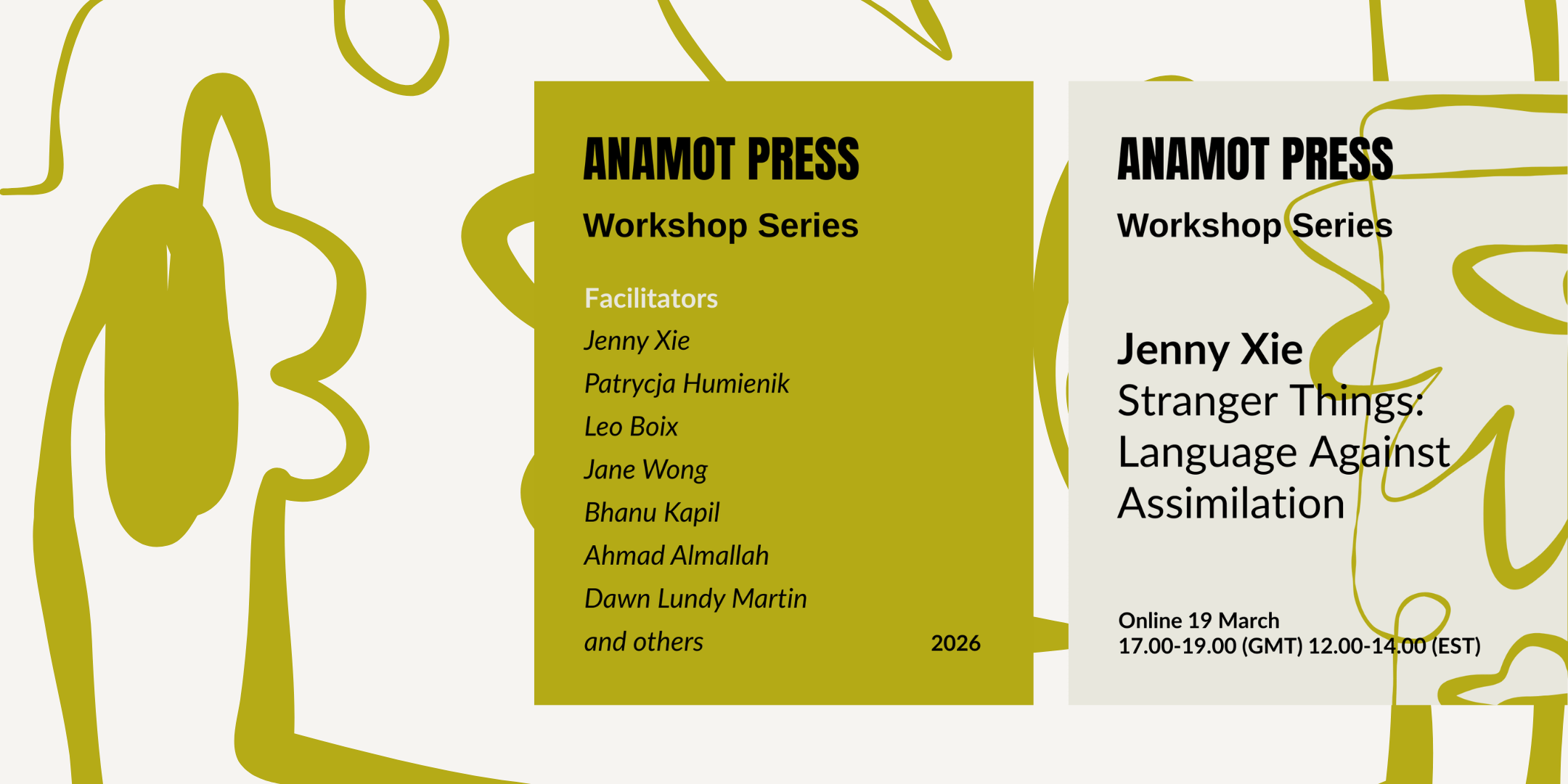
This workshop series includes some of my all time favourite writers and poets like Bhanu Kapil and Jenny Xie, alongside writers I’ve been reading last year and whose books have changed me in one way or another, like Patrycja Humienik and Dawn Lundy Martin. You can listen to my favourite podcast Between the Covers hosted by David Naimon, where Patrycja was a guest.
The guest poet/facilitators for these workshops are established writers from queer and/or diaspora communities around the world. Over the past year, I have been engaging with these writers’ works deeply and identifying specific themes from their bodies of work which now form the guiding threads for these 1.5 - 2 hour online workshops, facilitated by the writers.
Some of the themes include:
in search of a language that breathes behind their act of living
a poetics of devastation and transformation
(queer) letters to a forbidden lover (translating intentions, unspoken words, the unspeakable captured in language, sonnets, letters, archives)
a constellations of memory - familial and historical archives
The first online workshop will be facilitated by Jenny Xie on 19 March, 6-8pm (GMT).
Sign up here.
Writing workshops - in Armenian
Supported by the Calouste Gulbenkian Foundation – Armenian Communities Department
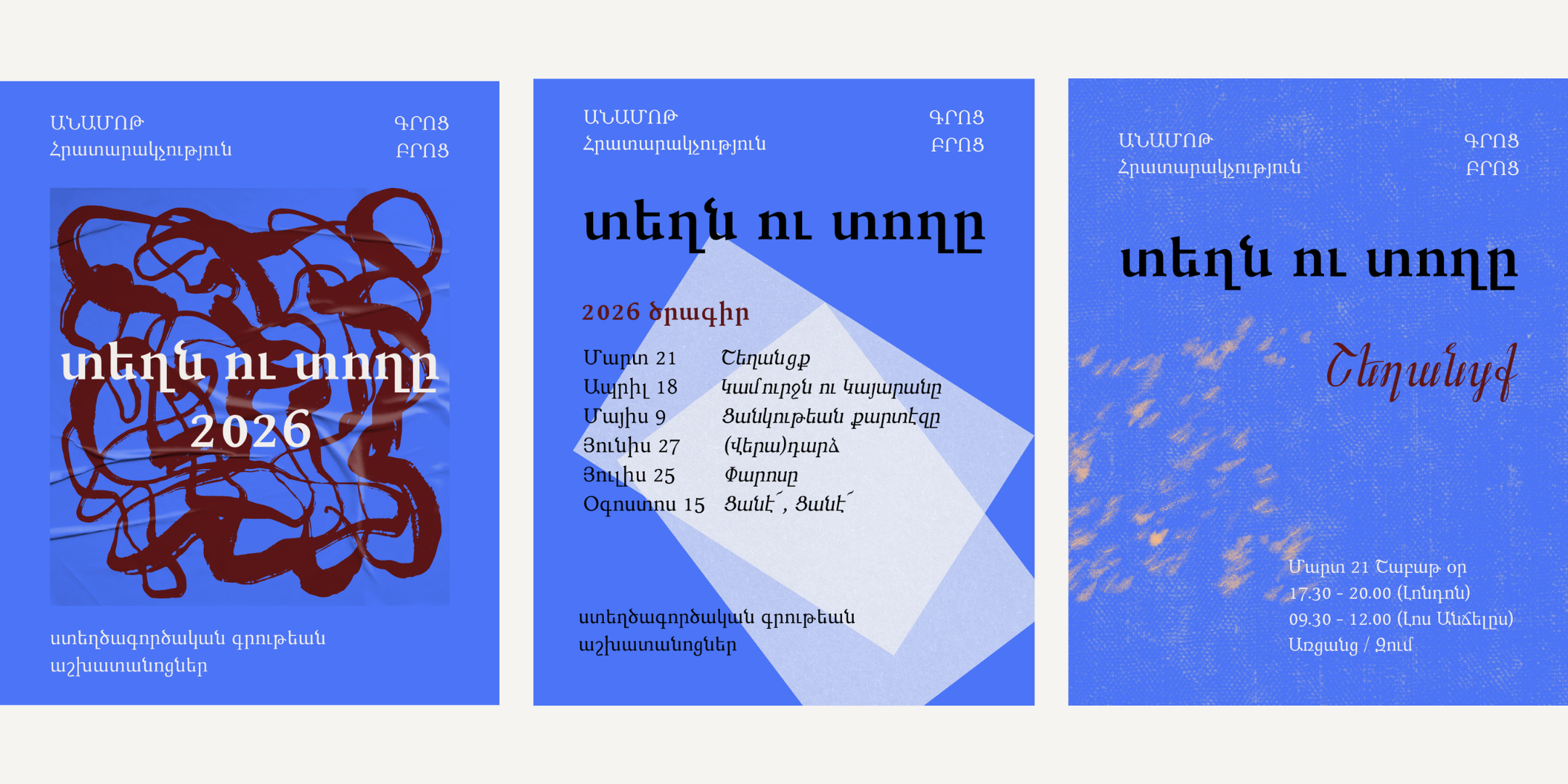
Our Armenian language reading and writing workshops series is facilitated by Alexia Hatun from Գրոց Բրոց and myself, Tatevik. We are grateful to the Calouste Gulbenkian Foundation – Armenian Communities Department for funding this programme.
Our 2026 programme will explore a range of texts by cult and contemporary Armenian writers and poets. In each session we will read extracts from one or two writers, and invite participants to respond to two writing prompts. We are excited to develop this unique space, and to invite the vast Armenian diaspora across the world (timezones permitting) to join us. In our pilot session in (November, 2025), we were joined by participants from Berlin, Copenhagen, Alaska, Istanbul, Yerevan, Beirut, Chicago, San Francisco, LA, London and various other places.
This series is a deeply meaningful part of the workshop programming for me. Last year, I was awarded a DYCP from Arts Council England to develop my editorial skills, interdisciplinary projects, and attend the AWP Bookfair in Los Angeles. Anamot Press and International Armenian Literary Alliance shared a table at the fair, which is where I met some of the LA-based Armenian writers and poets, such as Arthur Kayzakian, whose debut collection, The Book of Redacted Paintings, I’ve been admiring (and ordering into the National Poetry Library in London). During the bookfair, I also hosted two off-site events; one in collaboration with Lia Soorenian who hosts Ejanish, an Armenian reading group. Together, we co-facilitated a bilingual reading and writing workshop, with a guest performance by poet Armen Davoudian. I was inspired by the participants who shared their written responses to the prompts and overall the vital space that Lia nurtures through these gatherings. I also met Alexia at this workshop, where we briefly spoke about collaborating on online workshops in the future.
Less than a year later, Alexia and I have already facilitated a pilot session, Anamot Press has secured funding to deliver the series, and we have developed the curriculum for 2026. I am indebted to the hospitality, inspiration, and encouragement of the various LA Armenians I met during that trip. I’m immensely proud of Alexia and myself for developing this unique space for Armenian language writing, and for the endorsements we have received at this early stage.
This programme has been developed with care and intention, and yet I still find it hard to believe this trajectory and full-circle moment. I was homeschooled during my childhood and my mum taught me how to read and write; I only went to school in Yerevan for one year when I was 8 years old. Living in the diaspora, I didn’t go to Saturday school or further develop my Armenian language, reading, or writing. My next encounter with the language was in my 20s, when I worked at the Armenian Communities Department at the Calouste Gulbenkian Foundation in Lisbon. I remember attempting to read more in Armenian; I had asked the Director to bring me two books (Aram Pachyan and Hovhannes Tekgyozyan) back from one of his trips to Yerevan. I’ve been re-reading these books over the last year, as I have been reading and writing more in Armenian.
Our next workshop is on 21 March. Sign up here.
Anamot Press interdisciplinary workshops
In collaboration with Joyce Mak and The Feminist Library
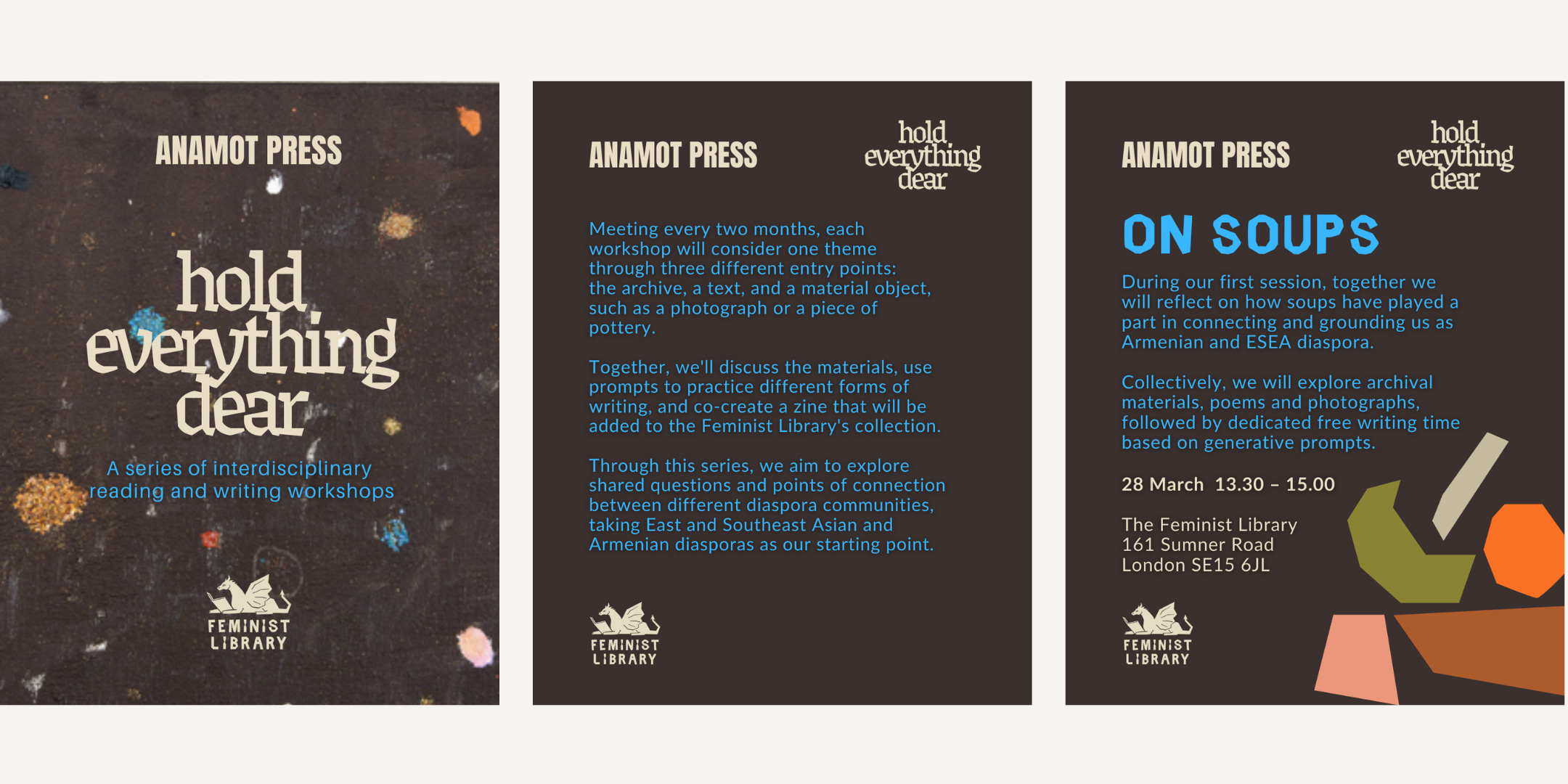
Hold everything dear is an interdisciplinary reading and writing group.
Meeting every two months, each session will consider one theme through three different entry points: the archive, a text, and a material object. Together, we will discuss the source materials, use prompts to practice different forms of writing, as well as co-create a zine that will be added to the Feminist Library’s collection.
The series is curated and facilitated by Joyce Mak and myself, Tatevik. We met through co-organising Strolling in Language (ESEA Sisters in Nature x Anamot Press), a nature walk and workshop commissioned by the Coast is Queer Literature Festival in Brighton.
Through this series, we aim to explore shared questions and points of connection between different diaspora communities, taking East and Southeast Asian and Armenian diasporas as our starting point.
Join us for our first session on 28 March at The Feminist Library in Peckham.
On Soups
During our first session together, we will reflect on how soups have played a part in connecting and grounding us as Armenian and ESEA diaspora. Collectively, we will explore archival materials, poems and photographs, followed by dedicated free writing time based on generative prompts.